![NovoSeven® RT (Coagulation Factor VIIa [Recombinant])](/content/dam/novonordisk/novoseven/global/logo-novoseven-rt.png)
Rely on NovoSeven® RT—it is proven effective to treat GT when platelets don't work at home. Clinical trials show it controls bleeds in a majority of GT-related bleeds, and in surgical procedures.

An effective therapy option for you.
NovoSeven® RT is the only recombinant treatment indicated for Glanzmann's thrombasthenia (GT) when platelets don't work.
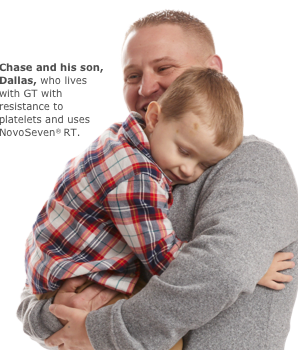
Why NovoSeven® RT?
Why NovoSeven® RT?

Controls bleeds, wherever and whenever they happen.
Bleed control seen in clinical trialsa
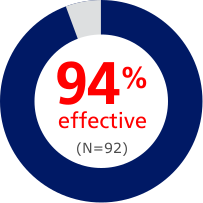
Bleeding episodes
266 episodes
All treatmentsb
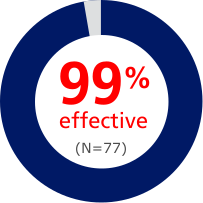
Surgical procedures
160 procedures
All treatmentsb
Effectiveness in childrena
- 94% bleed control in patients 0 to 12 years
–157 bleeding episodes in 43 patients, 19 surgical procedures in 15 patients - 100% bleed control in patients >12 to 16 years
–17 bleeding episodes in 8 patients, 3 surgical procedures in 3 patients
aEffectiveness seen in a prospective, observational, multinational study (from an analysis of published cases and people who took part in trials and registries).
bNovoSeven® RT only and NovoSeven® RT with platelets and/or antifibrinolytics.
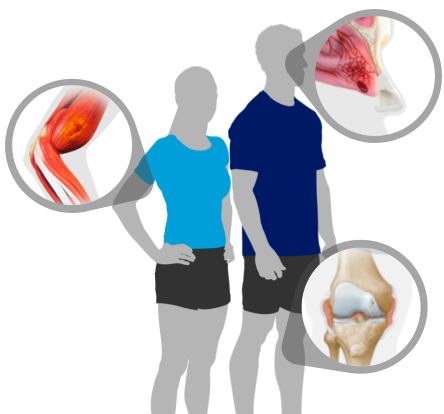
Stay prepared for bleeds
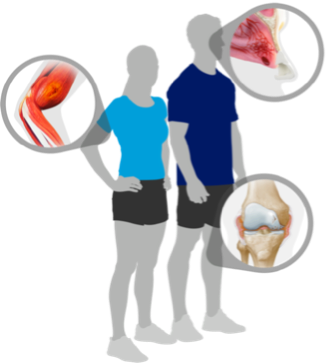
Did you know that identifying bleeds quickly is important? Learn the signs and symptoms of bleeds so you can identify them when and where they happen.

Safety supported by clinical experience.
NovoSeven® RT is a recombinant product, meaning it is made without human blood or plasma. This minimizes the possibility of viral contamination. NovoSeven® RT is the only recombinant therapy indicated for treatment of bleeding and prevention of bleeding for surgeries and procedures in adults and children with GT when platelets don’t work. And its safety is supported by real-world evidence, with a <0.2% rate of unexpected blood clots reported.
The most common and serious side effects of NovoSeven® RT are blood clots. Serious blood clots that form in veins and arteries with the use of NovoSeven® RT have been reported. Some signs of a blood clot may include pain, swelling, warmth, redness, or a lump in your legs or arms, chest pain, shortness of breath, or sudden severe headache and/or loss of consciousness or function.


Fast to infuse.
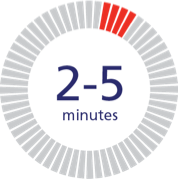
NovoSeven® RT provides low infusion volume, so infusing takes 2 to 5 minutes.c NovoSeven® RT is given as an intravenous (IV) bolus injection.
cAdminister as a slow bolus injection over 2 to 5 minutes, depending on the dose administered.
NovoSeven® RT (90 mcg/kg)
Meet Cathy.
She chooses NovoSeven® RT because it fits her lifestyle.

Goes where you go.
NovoSeven® RT is portable and travel ready, with compact packaging that’s easy to pack in a carry-on or backpack. And because it’s room temperature stable up to 77 °F , it requires no refrigeration.d
dNovoSeven® RT should be stored between 36 °F and 77 °F.
For complete storage information, please see Prescribing Information.
Quick to mix.e
NovoSeven® RT with MixPro® makes mixing a dose as easy as attach, twist, and mix. The prefilled syringe saves time—there are no extra steps to fill a syringe with diluent.

After mixing, NovoSeven® RT may be stored at room temperature in the vial for up to 3 hours.f
eCompared with mixing using histidine vials.
fNovoSeven® RT should be stored between 36 °F and 77 °F. For complete storage and handling instructions, please see Prescribing Information.

What if I need surgery or a procedure?
We understand that you have concerns about controlling bleeds if you ever need surgery or a procedure. The good news is that NovoSeven® RT prevents bleeds during and after surgery and procedures in people with GT when platelets don't work.
Talk to your doctor for more information on the surgical use of NovoSeven® RT.
Support for your care conversations
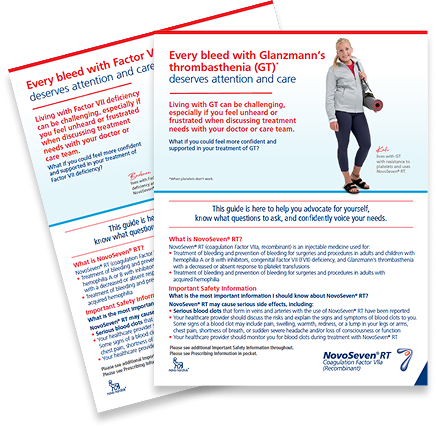
Explore tools and prompts created for people with GT when platelets don’t work to help you talk with your care team about your treatment needs.
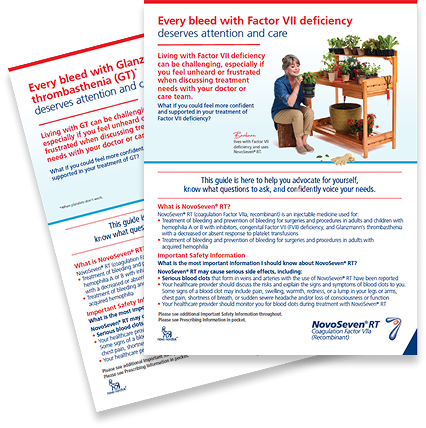
Support for your care conversations
Explore tools and prompts created for people with GT when platelets don’t work to help you talk with your care team about your treatment needs.

About Glanzmann’s thrombasthenia (GT).

What is GT?

There are proteins on the platelets that help your blood clot properly. One type of these proteins is a glycoprotein called IIb/IIIa, which helps platelets connect to each other. Those platelets stick together to form a "plug" that stops a bleed. Someone with GT has specific defective glycoprotein IIb/IIIa. This means the platelets cannot form a plug to stop a bleed.
Who gets GT?
GT is a rare genetic disorder that affects about 1 in 1 million people. It is inherited from both parents and can occur in both men and women.
What are the signs of GT?
Those with GT mainly have skin and mucous membrane types of bleeding. The most common signs of GT include:
- Easy bruising
- Bleeding from the nose or gums
- Heavy menstruation
Other signs and symptoms include:
- Excessive bleeding after trauma or surgery
- Excessive bleeding after dental extractions
What are some treatments for GT?
One treatment option for GT is platelet transfusion; some patients who receive platelet transfusions may develop antibodies and become resistant. You may be able to use a bypassing agent to control your bleeds if platelets do not work for you.
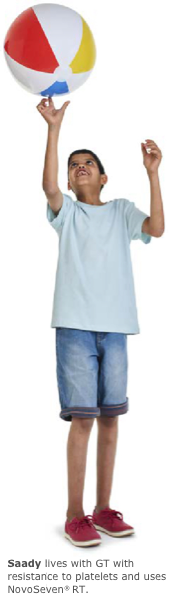

Hear from people who
share your experience.

New to treatment?
See how to get started.
![Icon: 5-step purification process of NovoSeven® RT (Coagulation Factor VIIa [Recombinant])](/content/dam/novonordisk/novoseven/cta/CTA-recombinant.jpg/jcr:content/renditions/webp2x)