![NovoSeven® RT (Coagulation Factor VIIa [Recombinant])](/content/dam/novonordisk/novoseven/global/logo-novoseven-rt.png)
Living with Glanzmann’s Thrombasthenia (GT) when
platelets don’t work or FVII deficiency
(FVIId) can be challenging—and not every doctor fully
understands your needs. These resources are
here to help you speak up, track your bleeds and bleeding
symptoms, and feel confident talking with
your care team.

Your voice matters.
Partnering with your doctor for care you deserve.
Your voice matters.
Partnering with your doctor for care you deserve.
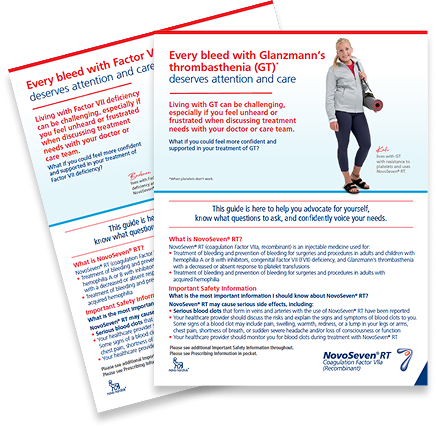
Living with Glanzmann’s Thrombasthenia (GT) when platelets don’t work or FVII deficiency (FVIId) can be challenging—and not every doctor fully understands your needs. These resources are here to help you speak up, track your bleeds and bleeding symptoms, and feel confident talking with
your care team.

Self-advocacy is key to managing your bleeding disorder. Keeping track of bleeds—when they happen, how long they last, what they look like with photos and videos, and how they affect your life—can help your doctor see the full picture.
Consider documenting the following:
Bleed type, frequency & duration
Helps your care team recognize bleed patterns or changes and determine if your current treatment plan is working as intended
Any pain or swelling that may signal joint bleeds
Early reporting to your doctor may help them identify potential joint issues and guide timely treatment adjustments

Photos and videos can provide clarity about your bleeding
Visual records help your care team track challenges and can assist you with shared decision-making conversations to discuss at-home access to treatment
Bringing this information to appointments helps guide more collaborative discussions about treatment options, including whether at-home access to NovoSeven® RT could be right for you.

Open conversations with your doctor can help clarify your treatment options and build confidence in advocating for your needs. Below are some examples of questions to ask.
Each of these questions can become part of an important discussion with your care team — helping you and your doctor plan ahead and find the right treatment approach for your needs.

Shared decision-making means you and your care team work together to find the best treatment plan for your needs. The more you share—your experiences, your concerns, and documentation—the more your doctor can tailor care that fits you.
Document your experiences
Bring a record of your bleeds, any patterns you’ve noticed, and how they’ve affected your day-to-day life.
Discover your options
Ask your care team to explain all available treatments, including whether NovoSeven® RT could be an option for managing bleeds at home.
Discuss your goals
Talk openly about what matters most to you, like feeling confident you can manage bleeds quickly and safely.

With rare bleeding disorders like GT when platelets don’t work or factor VII deficiency, you may also need to educate hospital staff about your bleeding disorder and treatment needs.
Below are questions and talking points to help you advocate for yourself or loved ones.

Find community support with your local Rare Blood Community Liaison (RBCL)
Your RBCL can help you:
- Practice how to start important conversations with your care team
- Learn what questions to ask
- Provide you with educational resources and connect with others living with rare bleeding disorders like GT when platelets don’t work and FVIId.

Reach out to your local RBCL to receive a self-advocacy shared decision making tool designed for people living with GT when platelets don't work or FVIId!
Reach out to your local RBCL to receive a self-advocacy shared decision making tool designed for people living with GT when platelets don't work or FVIId!

Real voices. Real strength.
Discover how others living with GT when platelets don’t work or FVIId navigate their care, advocate for themselves, and find confidence through connection.
Meet Taylor
“NovoSeven® RT helps me know that if I do get hurt, there’s something that will help me get through it. It’s something that has my back.”